
Chronic pain affects more than 20% of adults worldwide and remains one of the leading causes of disability and reduced quality of life. For the millions living with daily pain whether from arthritis, sciatica, spondylosis, frozen shoulder, or migraines the search for lasting, non-invasive relief is relentless. Ayurveda offers a 5,000-year-old answer: not just pain suppression, but root-cause healing that addresses the body, mind, and spirit together.
What Is Chronic Pain? The Ayurvedic View
In modern medicine, pain is labelled “chronic” when it persists beyond three months. But in Ayurveda, chronic pain is never an isolated symptom; it is a signal that the body’s fundamental balance has been disrupted.
The Ayurvedic term for pain is Shoola, and it is primarily associated with an aggravated Vata dosha, the energy governing movement, nerve impulses, and cellular communication. When Vata becomes imbalanced due to poor lifestyle, accumulated toxins (Ama), dietary errors, emotional stress, or physical injury, it disturbs the normal flow of Prana (life force) through the body’s channels (Srotas), resulting in pain, stiffness, numbness, and inflammation.
What makes the Ayurvedic approach uniquely powerful for chronic pain management is this: rather than muting a pain signal with medication, it investigates and corrects the underlying cause. This is why patients who have lived with pain for years and who have tried multiple conventional treatments often experience profound, lasting relief through Ayurvedic protocols.
Ayurveda does not treat the disease. It treats the person who has the disease restoring the body’s innate intelligence to heal itself.
— Foundational Principle of Ayurvedic Medicine
How Your Dosha Determines Your Pain
One of Ayurveda’s most practical insights is that pain is not the same for everyone its character, location, and triggers reflect your unique constitutional type (Prakriti) and the dominant dosha imbalance (Vikriti). Understanding this is the first step toward targeted, effective treatment.
Vata-Type Pain
Dry, sharp, migrating, shooting, or throbbing pain. Worse in cold weather, with movement, or under stress. Common in sciatica, back pain, and arthritis. Responds to warmth, oil, and Vata-pacifying therapies.
Pitta-Type Pain
Burning, inflamed, hot, and intense pain. Often with redness or swelling. Common in inflammatory arthritis, migraines, and abdominal pain. Responds to cooling, anti-inflammatory herbs, and Pitta-pacifying diet.
Kapha-Type Pain
Dull, heavy, aching, and congested pain. Worse in cold, damp weather. Common in spondylosis, frozen shoulder, and obesity-related joint pain. Responds to stimulating, heating, and Kapha-reducing therapies.
At Vivekananda Health Global, every patient undergoes a thorough Prakriti assessment and a detailed constitutional analysis before any treatment protocol is designed. This ensures your therapy is not generic but precisely calibrated to your body, your pain, and your life.
Chronic Pain Conditions We Treat
The Pain Management Clinic at Vivekananda Health Global specialises in the Ayurvedic management of a wide spectrum of chronic pain conditions. Each condition is addressed with a personalised protocol combining internal medicine, external therapies, and lifestyle modification.
Back Pain & Katishoola
Chronic lower back pain (called Katishoola in Ayurveda), disc bulges, herniated discs, lumbar spondylitis, and degenerative spinal conditions affect 60–70% of adults at some stage of life.
Sciatica
Radiating nerve pain from the lumbar spine through the buttock and leg, often presenting as burning, electric shock-like sensations or numbness a classic Vata imbalance pattern.
Arthritis
Both osteoarthritis (Sandhivata) and rheumatoid arthritis (Amavata), involve joint pain, stiffness, swelling, and progressive loss of mobility in knees, hips, and hands.
Migraine & Headache
Chronic, recurring migraines and tension headaches often rooted in Vata-Pitta imbalance and managed effectively with Shirodhara and targeted Nasya therapies.
Spondylosis
Cervical and lumbar spondylosis causing neck stiffness, radiating arm pain, and reduced spinal mobility addressed through Greeva Basti and Panchakarma protocols
Frozen Shoulder
Adhesive capsulitis causing progressive loss of shoulder range-of-motion and chronic dull-to-sharp pain, treated with Pinda Sweda, Nasya, and targeted Pizhichil.
Sinusitis
Chronic sinus pressure and facial pain are Kapha-Vata conditions treated with Nasya (medicated nasal therapy), steam inhalation, and dietary corrections.
Pelvic & Abdominal Pain
IBS, gastritis, menstrual pain, endometriosis, and kidney stone-related pain are addressed through Basti therapies, herbal formulations, and diet protocols.
Panchakarma: The Gold Standard for Chronic Pain
Panchakarma is literally “five actions” is Ayurveda’s most comprehensive therapeutic system. It is not a single therapy but an orchestrated sequence of cleansing and rejuvenating procedures designed to eliminate deep-seated toxins (Ama), restore dosha balance, and revitalise damaged tissues. For chronic pain, Panchakarma is unmatched in its ability to create lasting results.
Panchakarma
Basti Medicated Enema TherapyConsidered the single most powerful treatment for Vata disorders, Basti introduces carefully formulated medicated oils or herbal decoctions into the colon — the primary seat of Vata. Matra Basti, Sneha Basti, and Kashaya Basti offer targeted relief for back pain, sciatica, and degenerative joint conditions. It also relieves constipation and corrects digestive disorders that frequently underlie chronic pain.
Panchakarma
Virechana Therapeutic Purgation
A controlled, medicated purgation that powerfully eliminates Pitta toxins from the liver, intestines, and blood. Virechana is the cornerstone treatment for inflammatory pain conditions — including inflammatory arthritis, migraine, and skin disorders accompanied by pain — by purifying the body at a deep tissue level.
Panchakarma
Agni Karma Thermal Cauterisation
A precise, minimally invasive therapy using controlled heat application on specific pain points. Particularly effective for stubborn, localised pain unresponsive to other treatments, including heel pain, trigger points, and deep joint aches. Agni Karma offers long-lasting relief by stimulating tissue repair and nerve recalibration.
Panchakarma
Nasya Nasal Administration of Medicine
Medicated oils or herbal preparations administered through the nostrils to cleanse and nourish the upper channels. Nasya is the primary therapy for cervical spondylosis, chronic headaches, frozen shoulder, and sinusitis conditions rooted in Vata-Kapha imbalances in the head and neck region.
External Ayurvedic Therapies for Pain Relief
Beyond internal cleansing, Ayurveda’s external treatment arsenal is extraordinarily sophisticated. These therapies work directly on the musculoskeletal system, nervous tissue, and skin to deliver medicated substances deep into the body, stimulate circulation, reduce inflammation, and restore mobility.
External Therapy
Abhyanga Full-Body Medicated Oil Massage
A rhythmic, full-body massage using warm medicated oils chosen specifically for your dosha and condition. Abhyanga enhances tissue strength, stimulates lymphatic and blood circulation, relieves stiffness, nourishes joints, and calms an aggravated nervous system. It is the foundation of almost every chronic pain treatment protocol at VHG.
External Therapy
Kati Basti Pooled Oil Therapy for Back Pain
A dough ring is formed on the lower back and filled with warm, medicated oil that is retained for a set duration. The sustained heat and oil penetration relieve lumbar muscle tension, nourish intervertebral discs, reduce inflammation around spinal nerves, and provide dramatic relief from chronic lower back pain, disc pathology, and sacroiliac dysfunction.
External Therapy
Shirodhara Continuous Oil Stream on the Forehead
A continuous, rhythmic stream of warm medicated oil poured onto the forehead (the Ajna point) induces a profound state of neurological calm. Shirodhara is the definitive Ayurvedic therapy for migraine, stress-related chronic pain, insomnia, anxiety, and conditions where pain has a strong psychosomatic component. It nourishes the entire head region — the seat of all sense organs.
External Therapy
Kizhi (Pinda Sweda) Herbal Pouch Fomentation
Bundles of medicinal herbs, rice, or sand are heated and rhythmically applied to the body. Choorna Pinda Sweda uses dry herbal powders for Kapha-type pain and stiffness; Navara Kizhi (Njavarakizhi) uses medicated milk-cooked rice for deep tissue nourishment and nerve regeneration. These therapies are particularly effective for arthritis, spondylosis, muscular pain, and post-injury rehabilitation.
External Therapy
Kaya Seka (Pizhichil) Oil Bath Therapy
Warm medicated oil is continuously poured over the entire body while therapists simultaneously massage the patient. Called the “treatment of kings,” Pizhichil is a supreme therapy for neurological pain, paralysis, acute back pain, and musculoskeletal degeneration. It stimulates nerves, promotes healing chemicals, and creates profound tissue-level restoration.
External Therapy
Lepana Medicated Herbal Paste Application
A thick paste of anti-inflammatory and analgesic herbs is applied to the painful area and sealed with leaves and bandaging. The combination of herbal pharmacology and localised heat deeply relaxes muscles, reduces swelling, and provides significant relief for acute and chronic joint pain, tendinitis, and localised injuries.
External Therapy
Kati Pichu Warm Oil Compress for the Back
Medicated oil-soaked cotton wool is placed over the lumbar region and maintained at therapeutic temperature. A gentler alternative to Kati Basti, Kati Pichu is particularly suitable for sensitive patients, acute flares, or as a maintenance therapy between more intensive treatment cycles.
Ayurvedic Herbs & Formulations for Chronic Pain
Ayurvedic pharmacology for pain is vast, precise, and profoundly effective. Unlike isolated pharmaceutical compounds, Ayurvedic formulations are synergistic blends of multiple plant constituents that work together to reduce inflammation, pacify the relevant dosha, repair tissues, and restore digestive fire (Agni) — because optimal digestion is foundational to pain-free living. Below are the most clinically significant herbs used at Vivekananda Health Global.
| Herb / Formulation | Sanskrit Name | Key Action | Best For |
|---|---|---|---|
| Ashwagandha | Withania somnifera | Adaptogenic, anti-inflammatory, nerve tonic | Chronic fatigue pain, muscle weakness, nerve damage |
| Shallaki | Boswellia serrata | Potent anti-inflammatory, cartilage-protective | Arthritis, osteoarthritis, knee pain, spondylosis |
| Guggulu | Commiphora mukul | Detoxifying, anti-arthritic, lipid-modulating | Rheumatoid arthritis, sciatica, obesity-related pain |
| Nirgundi | Vitex negundo | Analgesic, antispasmodic, anti-inflammatory | Back pain, sciatica, joint stiffness, muscle spasms |
| Dashamoola | Ten-root formulation | Vata-pacifying, pain-relieving, nervine tonic | Generalised body pain, neurological pain, chronic Vata disorders |
| Turmeric (Haridra) | Curcuma longa | Broad-spectrum anti-inflammatory (curcumin) | All inflammatory pain conditions, arthritis, injuries |
| Eranda (Castor) | Ricinus communis | Vata-pacifying, purgative, joint-lubricating | Rheumatoid arthritis, gout, constipation-driven back pain |
| Mahanarayana Taila | Classic medicated oil | Musculoskeletal tonic, deep tissue penetration | Back pain, arthritis, spondylosis, muscle wasting |
All herbal prescriptions at Vivekananda Health Global are individualised by qualified Ayurvedic physicians based on your Prakriti, current health status, and any conventional medications you may be taking. Self-medication is never advised.
Diet, Yoga & Lifestyle in Chronic Pain Management
Ayurveda teaches that treatment without lifestyle change is incomplete. The most powerful external therapies and herbal formulations will have limited long-term impact if the underlying dietary and behavioural patterns that created the imbalance are left unchanged. At VHG, every chronic pain patient receives comprehensive diet counselling and a personalised yoga therapy programme as integral parts of their treatment plan.
Ayurvedic Dietary Principles for Pain
For most chronic pain conditions rooted in Vata aggravation, the diet should emphasise warm, moist, nourishing, and easily digestible foods. Cold, raw, processed, and excessively dry foods increase Vata and worsen pain. Inflammatory conditions (Pitta-type pain) require cooling, light, and non-acidic foods, avoiding spicy, fermented, and fried items. Kapha-type pain benefits from a light, stimulating, and warming diet that reduces mucus and fluid accumulation.
The Lifestyle Management Clinic at VHG provides individualised nutritional counselling based on the principles of Ayurveda and Yoga, helping patients understand how their daily food choices either aggravate or alleviate their pain.
Yoga Therapy for Chronic Pain
Yoga therapy is not a one-size-fits-all exercise prescription — it is a medically supervised, condition-specific therapeutic modality that has been validated in peer-reviewed clinical research as a safe and effective method for chronic pain management. At VHG, yoga therapy for pain incorporates targeted asanas to strengthen and decompress the spine, pranayama (breathing exercises) to regulate the nervous system, and meditation to address the psycho-emotional dimensions of chronic pain. This integration significantly enhances the outcomes of Ayurvedic treatment and reduces pain recurrence.
Daily Routine (Dinacharya) for Pain Prevention
Ayurveda’s concept of Dinacharya — a structured daily routine aligned with natural rhythms — is one of its most powerful preventive tools. Regular sleep and wake times, self-massage with warm oil (Abhyanga), mindful meals eaten at consistent times, and avoidance of erratic habits all work to keep Vata pacified and pain at bay. Even simple practices like avoiding cold exposure, maintaining good posture, and taking short walking breaks from prolonged sitting can meaningfully reduce chronic pain burden over time.
Your Treatment Journey at Vivekananda Health Global
At VHG, chronic pain treatment is never rushed or standardised. Every patient’s journey is individually crafted by experienced Ayurvedic physicians who take the time to understand the full picture — your history, your constitution, your pain patterns, and your goals.
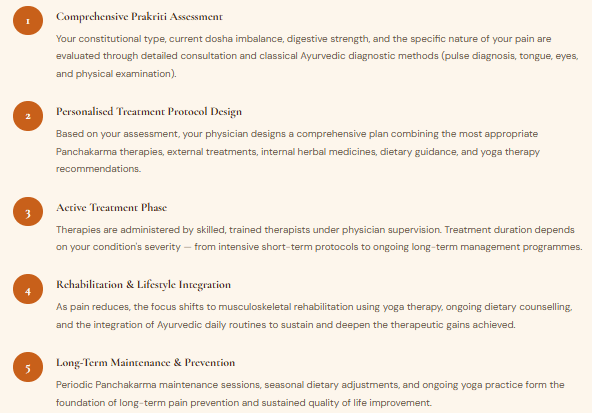
Vivekananda Health Global (VHG) is an initiative of Vyasa Health Care, Bengaluru, which operates NABH-accredited centres at HSR Layout, HRBR Layout, Bengaluru; Thiruvananthapuram; Guwahati; Ahmedabad; Seoul; and New York. Online consultations are available globally.