
What Is Ayurveda & What Are Doshas?
Ayurveda — literally meaning “the science of life” in Sanskrit — is one of the world’s oldest holistic healing systems, originating in India over 5,000 years ago. It is rooted in the belief that health is a dynamic balance between body, mind, and spirit, and that every individual is unique.
At the heart of Ayurvedic medicine is the concept of the three doshas: Vata, Pitta, and Kapha. These are biological energies derived from the five elements — earth, water, fire, air, and space (ether). Each dosha governs specific physiological and psychological functions, and every human being is born with a unique combination of all three, known as their prakriti (individual constitution).
Key Concept
The World Health Organization (WHO) recognises Ayurveda as a traditional medicine system. Research published in the Journal of Ethnopharmacologyand other peer-reviewed outlets has increasingly explored the biomedical basis of dosha theory and Ayurvedic interventions.
Your dosha is not a personality type or a trend — it is a comprehensive map of your biological tendencies, vulnerabilities, and strengths. Understanding your dominant dosha empowers you to make smarter choices around food, sleep, exercise, relationships, and seasonal routines.
Overview of the Three Ayurvedic Body Types
Here is a quick snapshot of each dosha — their elemental composition, primary qualities, and core tendencies. Most people are bi-doshic (two doshas in roughly equal proportion), while a small percentage are tri-doshic.
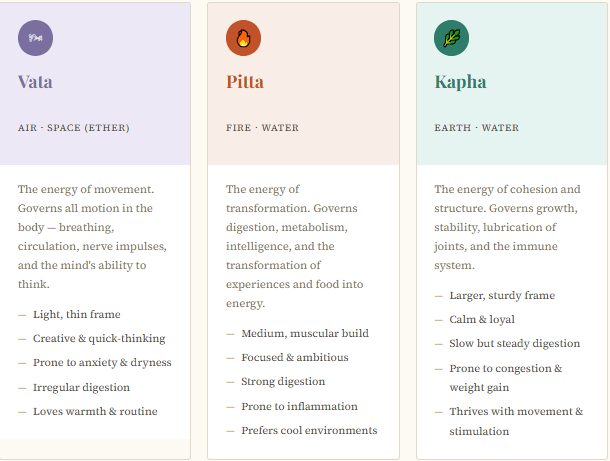
Vata Dosha — The Energy of Movement
Primary elements: Air (Vayu) and Space (Akasha)
Key qualities: Dry, light, cold, rough, subtle, mobile, clear
Vata is the most powerful of the three doshas because it governs movement — and without movement, neither Pitta nor Kapha can function. When Vata is in balance, it promotes creativity, adaptability, and lightness of being. When imbalanced, it leads to anxiety, irregular digestion, insomnia, and dryness.
Physical Characteristics of Vata Types
Vata-dominant individuals tend to have a light, slender body frame with prominent joints and visible veins. Their skin is often dry and tends to crack in cold weather. Hair may be thin, dry, and prone to breakage. They are typically quick walkers and fast talkers.
Psychological & Emotional Traits
Vata types are imaginative, enthusiastic, and fast learners — but they can also forget things quickly. They are adaptable and spontaneous but may struggle with anxiety, restlessness, and difficulty making decisions. They tend to be highly sensitive to noise and environmental changes.
Common Health Vulnerabilities
- Anxiety, worry, and racing thoughts
- Bloating, gas, and constipation
- Dry skin, chapped lips, and brittle nails
- Joint pain and cracking joints
- Insomnia and irregular sleep patterns
Vata-Balancing Diet & Lifestyle Tips
- Favour warm, oily, and nourishing foods — soups, stews, ghee, sesame oil, and cooked root vegetables.
- Avoid raw, cold, and dry foods — raw salads, crackers, and cold smoothies aggravate Vata.
- Establish daily routines — Vata thrives on consistent wake, meal, and sleep times.
- Favour gentle, grounding exercise — yoga, tai chi, walking, and swimming over intense cardio.
- Practise Abhyanga (self-massage with warm sesame or almond oil) daily before bathing.
- Prioritise warmth — dress in warm layers, avoid cold drafts, and favour warmer climates.
Ayurvedic Insight
In Ayurveda, the seat of Vata in the body is the colon. Most Vata-related imbalances, from constipation to anxiety, can be traced back to disturbances in the colon. Warm, fibre-rich foods and oil therapies (Basti) are therefore central to Vata management.
Pitta Dosha — The Energy of Transformation
Primary elements: Fire (Agni) and Water (Jala)
Key qualities: Hot, sharp, light, oily, liquid, spreading, sour smell
Pitta governs all transformative processes: digestion of food, metabolism of thoughts, and the conversion of experience into wisdom. When balanced, Pitta expresses itself as intelligence, confidence, courage, and excellent digestive fire (agni). When excess Pitta accumulates, it manifests as inflammation, irritability, acid reflux, and skin rashes.
Physical Characteristics of Pitta Types
Pitta-dominant people generally have a medium, well-proportioned build with good muscle tone. They tend to have warm, reddish, or oily skin that is prone to acne, rashes, and sunburn. Hair is often fine, soft, and tends to grey or thin early. They may have an intense gaze and a strong, penetrating voice.
Psychological & Emotional Traits
Pitta types are natural leaders, focused, decisive, and highly motivated. They have a sharp intellect and excellent concentration. The shadow side of Pitta is a tendency towards perfectionism, competitiveness, anger, and judgement when imbalanced. They are passionate but can become controlling under stress.
Common Health Vulnerabilities
- Acid reflux, heartburn, and gastric ulcers
- Skin conditions: acne, eczema, rosacea
- Inflammation and hot sensations in the body
- Anger, irritability, and impatience
- Premature greying or hair loss
Pitta-Balancing Diet & Lifestyle Tips
- Favour cooling, bitter, and sweet foods — cucumber, coconut, leafy greens, dairy (if tolerated), and sweet fruits.
- Avoid hot, spicy, fermented, and acidic foods — chilies, vinegar, alcohol, and fried foods inflame Pitta.
- Never skip meals — Pitta has a strong metabolic fire; irregular eating leads to irritability and gastric issues.
- Favour cooling exercise — swimming, cycling in cool air, and yoga over high-heat activities like Bikram yoga.
- Cultivate patience and compassion — mindfulness, journaling, and time in nature help cool an overactive Pitta mind.
- Use cooling oils — coconut or sunflower oil for self-massage; avoid sesame oil which is heating.
Kapha Dosha — The Energy of Structure
Primary elements: Earth (Prithvi) and Water (Jala)
Key qualities: Heavy, slow, cool, oily, smooth, dense, soft, stable, cloudy
Kapha is the dosha of building and binding. It provides the physical substance and structure of the body, lubricates joints, maintains immunity, and supports emotional steadiness. A balanced Kapha person is loving, patient, and strong. When Kapha becomes excessive, it leads to lethargy, weight gain, congestion, and emotional clinging.
Physical Characteristics of Kapha Types
Kapha-dominant individuals tend to have a larger, heavier, and well-built frame with broad shoulders and wide hips. Their skin is smooth, thick, and pale, often cool to the touch. They have large, expressive eyes and thick, lustrous hair. They tend to gain weight easily and lose it slowly.
Psychological & Emotional Traits
Kapha types are the most emotionally stable of the three doshas. They are loving, loyal, patient, and deeply compassionate. They tend to be slower to learn but possess excellent long-term memory. The imbalanced shadow of Kapha is attachment, possessiveness, stubbornness, depression, and resistance to change.
Common Health Vulnerabilities
- Weight gain and difficulty losing weight
- Congestion, sinusitis, and respiratory conditions
- Sluggish digestion and slow metabolism
- Water retention and oedema
- Depression, emotional attachment, and lethargy
Kapha-Balancing Diet & Lifestyle Tips
- Favour light, dry, and spicy foods — legumes, bitter greens, ginger, turmeric, and most spices stimulate Kapha’s sluggish digestion.
- Avoid heavy, oily, sweet, and cold foods — dairy, wheat, sweets, and fried foods increase Kapha.
- Exercise vigorously and regularly — Kapha benefits most from vigorous daily movement: running, dancing, cycling, or HIIT.
- Wake early — ideally before 6 AM; sleeping in or napping during the day increases Kapha heaviness.
- Seek stimulation and variety — new experiences, social engagement, and learning new skills counter Kapha’s tendency towards stagnation.
- Use dry massage (Garshana) — raw silk or a dry brush stimulates circulation and lymphatic drainage.
Dosha Comparison at a Glance
Use this table as a quick reference to compare the three doshas across key areas of physical and mental life.
| Attribute | Vata | Pitta | Kapha |
| Elements | Air + Space | Fire + Water | Earth + Water |
| Body Frame | Thin, light, bony | Medium, muscular | Large, sturdy, heavy |
| Skin | Dry, rough, thin | Oily, warm, reddish | Smooth, cool, pale |
| Digestion | Variable, irregular | Strong, sharp | Slow, steady |
| Appetite | Variable | Strong, frequent hunger | Low, consistent |
| Sleep | Light, interrupted | Moderate, intense dreams | Heavy, long, deep |
| Personality | Creative, anxious, adaptable | Ambitious, focused, intense | Calm, loving, stable |
| Emotional challenge | Fear, anxiety | Anger, jealousy | Attachment, depression |
| Best exercise | Gentle: yoga, walking | Moderate: swimming, cycling | Vigorous: running, HIIT |
| Best season | Summer (avoid cold) | Winter (avoid heat) | Summer (avoid cold & damp) |
| Imbalanced by | Irregular routine, cold, dryness | Heat, spicy food, stress | Inactivity, heavy food, cold |
| Seat in body | Colon | Small intestine | Stomach & lungs |
How to Identify Your Ayurvedic Body Type (Prakriti)
Identifying your prakriti (constitutional type) is ideally done through a consultation with a qualified Ayurvedic practitioner, they assess pulse diagnosis (nadi pariksha), physical examination, and a detailed lifestyle interview. However, a structured self-assessment is an excellent starting point.
Key Areas to Assess
- Physical frame — Are you naturally thin and light (Vata), medium and muscular (Pitta), or large and heavy-set (Kapha)?
- Skin & hair — Dry and thin (Vata), warm, oily, prone to breakouts (Pitta), or smooth, thick, and pale (Kapha)?
- Digestion — Irregular and gassy (Vata), strong and intense with intolerance to spice (Pitta), or slow and steady (Kapha)?
- Sleep patterns — Light and interrupted (Vata), moderate with vivid dreams (Pitta), or deep and prolonged (Kapha)?
- Mental tendencies — Quick but scattered (Vata), sharp and analytical (Pitta), or slow but excellent memory (Kapha)?
- Emotional default — Anxious (Vata), intense and irritable (Pitta), or calm and attached (Kapha)?
Important Note
Most people are bi-doshic, a combination of two dominant doshas such as Vata-Pitta or Pitta-Kapha. A tri-doshic constitution (all three in balance) is relatively rare and is considered the most resilient. Your dosha quiz results should always be validated by a trained Ayurvedic practitioner for personalised guidance.

Balancing Your Dosha: A Holistic Approach
Ayurveda does not advocate for eliminating any dosha — all three are necessary and present in every person. The goal is balance, which Ayurveda calls svastha (being established in oneself). Balance is seasonal, age-dependent, and deeply personal.
Dinacharya — Daily Routine as Medicine
Ayurveda prescribes dinacharya (daily routine) as one of the most powerful tools for maintaining dosha balance. This includes waking at sunrise, tongue scraping, oil pulling, self-massage, yoga and pranayama, mindful eating at regular times, and wind-down practices before sleep.
Ritucharya — Seasonal Lifestyle Adjustments
Each season naturally increases certain doshas: Vata rises in autumn and early winter, Pitta peaks in summer, and Kapha accumulates in late winter and spring. Adjusting your diet and routine with the seasons — ritucharya — is a cornerstone of Ayurvedic preventive health.
Panchakarma — Deep Detoxification
For deeper constitutional cleansing, Ayurveda recommends Panchakarma — a five-action detoxification programme conducted under the supervision of an Ayurvedic physician. This includes therapeutic emesis, purgation, medicated enemas, nasal cleansing, and blood purification therapies, tailored to your dominant dosha and current imbalance.
Frequently Asked Questions
What are the three Ayurvedic body types?
The three Ayurvedic body types (doshas) are Vata (composed of air and space), Pitta (fire and water), and Kapha (earth and water). Each governs specific physiological and psychological functions. Most people are a blend of two doshas, with one being dominant.
How do I find out my Ayurvedic body type?
You can begin with a structured self-assessment covering body frame, skin type, digestion, sleep, and emotional tendencies. For the most accurate results, consult a qualified Ayurvedic practitioner who can assess your prakriti through pulse diagnosis (nadi pariksha) and a thorough consultation.
Can your dosha change over time?
Your core constitutional type (prakriti) is determined at conception and remains fixed. However, your current dosha state (vikriti) can become imbalanced due to diet, stress, seasonal changes, and lifestyle choices. Ayurvedic treatment focuses on restoring your vikriti back to your natural prakriti.
Is it possible to be all three doshas equally?
Yes — a tri-doshic constitution (sama prakriti) where all three doshas are present in roughly equal measure is possible but relatively rare. It is considered particularly resilient when in balance, though achieving balance across all three simultaneously can be more complex.
What is the best diet for each dosha?
Vata benefits from warm, oily, and nourishing cooked foods. Pitta should favour cooling, bitter, and mildly sweet foods while avoiding spice and heat. Kapha does best with light, dry, spicy, and stimulating foods while avoiding heavy, oily, or cold meals. Diet should always be adjusted seasonally and in consultation with a practitioner.